Neptune: The Planet That Shouldn't Be This Angry
On Neptune, the wind blows at 2,000 kilometres per hour. The planet sits thirty times further from the Sun than we do, where sunlight barely reaches. It should be a still, frozen marble. Instead it has the most violent weather in the solar system. Nobody is sure why.
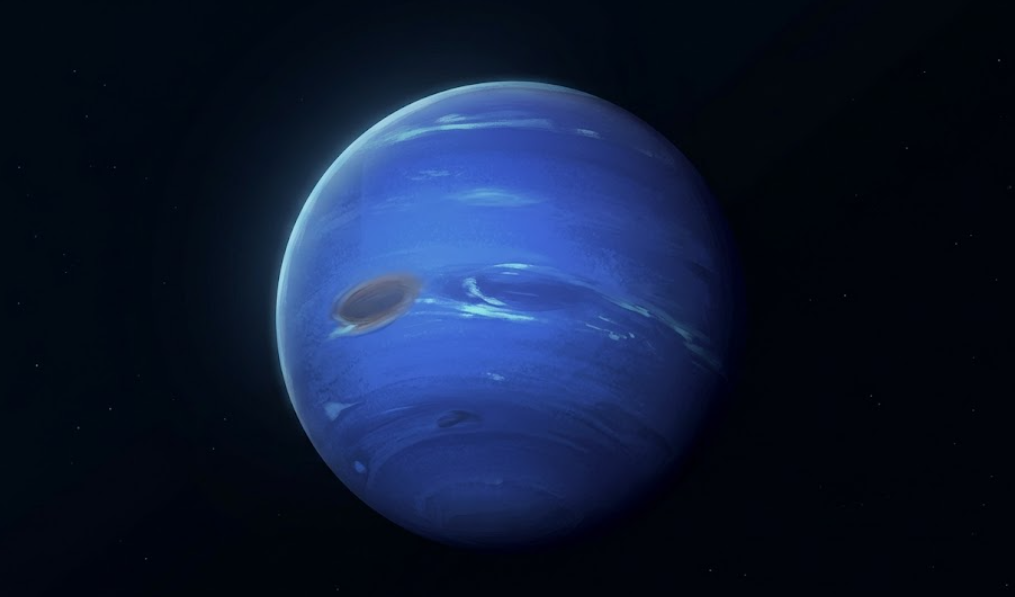
On Neptune, the wind blows at 2,000 kilometres per hour. That is faster than a fighter jet. Faster than the speed of sound on Earth, five times over. Storms the size of our planet tear across the upper atmosphere at speeds nothing on Earth comes close to.
And here is the part that makes no sense: Neptune barely gets any sunlight.
The energy problem
Wind, anywhere in the universe, is a symptom of energy. On Earth, the Sun heats the equator more than the poles. Warm air rises, cool air rushes in to fill the space, and the planet spins underneath it all. That is where our weather comes from. Hurricanes, jet streams, the breeze that moves the curtains. All of it is the Sun, doing work on air.
Neptune sits thirty times further from the Sun than we do. By the time sunlight reaches it, there is almost nothing left. A summer afternoon on Neptune is dimmer than twilight on Earth. If you want to make that distance real for a child, we once built a model of the whole solar system on a football field and walked out to where Neptune would sit. The planet should be still. A frozen blue marble, drifting quietly in the dark.
Instead, it has the most violent weather in the solar system. Neptune is not the only world where weather defies expectation. On Titan, a gentle breeze produces waves taller than a person, rolling in slow motion across seas of liquid methane.
Where the energy comes from
Nobody is entirely sure. That is a genuine answer, not a hedge. Neptune releases more than twice as much heat as it receives from the Sun, which means the energy is coming from inside the planet itself. Something deep down is still hot, and still leaking that heat upward. Whatever is happening in Neptune's core, it is the engine driving those 2,000 km/h winds.
The leading guess: Neptune is still contracting under its own gravity, and that squeeze is releasing heat the planet has been storing since it formed 4.5 billion years ago. A slow, gravitational furnace. A world powered not by starlight but by its own weight, pressing down on itself.
Which is, honestly, a bit unsettling. A planet running on its own insides.
The moon that came from somewhere else
Neptune has a companion that makes the winds look tame. Its biggest moon, Triton, orbits the wrong way.
Every other large moon in the solar system orbits its planet in the same direction the planet spins. Triton does the opposite. It circles Neptune backwards, which tells astronomers something remarkable: Triton did not form alongside Neptune the way our Moon formed alongside Earth. It formed somewhere else, drifted too close, and got captured.
Triton is almost certainly a kidnapped world from the Kuiper Belt, the ring of icy bodies out beyond Neptune. Pluto's cousin, pulled off course and locked into an alien sky. It even looks the part: pale, pinkish, covered in frozen nitrogen, with geysers that shoot crystals of ice miles into space.
And it is slowly spiralling inward. Every orbit, Triton gets a tiny bit closer to Neptune. In a few billion years, it will cross a line called the Roche limit, and Neptune's gravity will tear it apart. Triton will become a ring.
Neptune does not have much of a ring system right now. One day it will. Saturn wore its crown late too: those famous rings may have formed long after the planet itself.
A planet found on paper
One more thing about Neptune, because it is the only planet we discovered this way. Nobody saw Neptune first. A mathematician found it.
In the 1840s, astronomers noticed Uranus was not moving quite right. Something unseen was tugging on it. Two mathematicians, working separately in France and England, calculated where that something would have to be. When a telescope was finally pointed at the predicted spot, Neptune was sitting exactly where the maths said it would be, within one degree.
The planet was found with a pencil before it was found with a lens. That has never happened again.
Neptune is the quietest-looking planet in our solar system. From a distance, it is a smooth blue disc, almost featureless, drifting in a part of space so dark and cold it barely counts as part of the Sun's family. You could easily believe nothing is happening there.
Except supersonic winds are ripping through its atmosphere. A stolen moon is spiralling toward its destruction. And deep inside, something old and hot is still burning, four and a half billion years after it started.
The dimmest planet is the loudest. You just have to get close enough to hear it.