Uranus: The Planet That Fell Over
Uranus looks like the quietest planet in the solar system. Beneath that blank face: a world knocked sideways by a planet-sized impact, hiding its heat behind invisible barriers, raining diamonds into its own depths. We've visited once. We stayed a few hours.
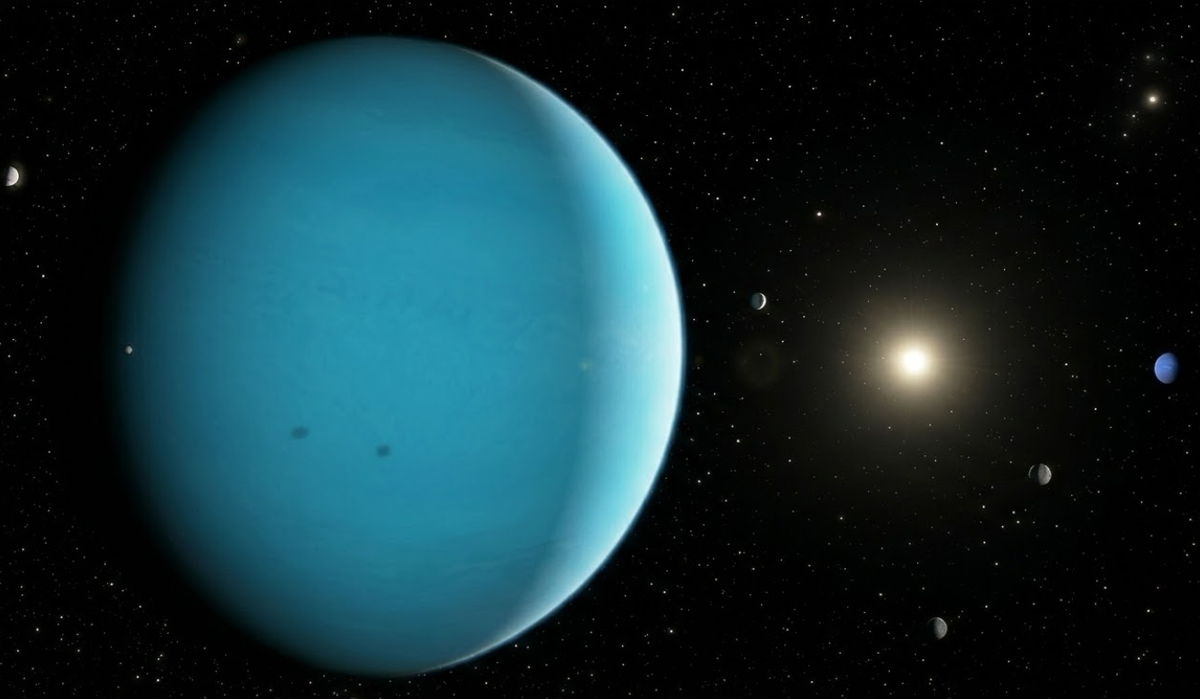
Uranus doesn't spin like the other planets. Every world in the solar system rotates roughly upright, like tops on a table. Uranus rolls. It's tilted 98 degrees from vertical, which means it essentially orbits the Sun on its side, like a ball someone knocked over and never set right.
That's probably exactly what happened. Early in the solar system's history, something roughly the size of Earth slammed into Uranus and tipped it sideways. The collision was violent enough to fundamentally change how the planet experiences everything. Seasons on Uranus don't work the way they work anywhere else: each pole gets 42 years of continuous sunlight, then 42 years of total darkness. One long day, one long night, each lasting longer than most human lifetimes.
A World That Hides
For most of history, nobody knew Uranus was there. It's visible to the naked eye (barely), but it moves so slowly against the background stars that ancient astronomers assumed it was just another faint dot in the sky. Hipparchos logged it as a star in 128 BC. John Flamsteed observed it at least five times in the 1690s without realising what he was seeing. It took until 1781, when William Herschel spotted it through a telescope from his garden in Bath, for anyone to notice it was moving. Even then, Herschel thought it was a comet.
It took two more years for astronomers to agree: this was a planet, the first one discovered in recorded history. Herschel wanted to name it after King George III (which is honestly a bit much). Thankfully, the name that stuck was Uranus, after the Greek god of the sky. It's the only planet named for a Greek deity rather than a Roman one.
Cold, Quiet, and Strange
Uranus is classified as an ice giant, but the name is misleading. The "ice" inside Uranus isn't frozen. It's a superheated, pressurised fluid made of water, methane, and ammonia, crushed into states of matter that don't exist naturally on Earth. The temperature at the core may reach 5,000°C, but the upper atmosphere is the coldest of any planet in the solar system: around minus 224°C.
Here's the strange part. Most large planets radiate significantly more heat than they receive from the Sun. Jupiter does. Saturn does. Neptune does. Uranus barely radiates any excess heat at all. For decades, scientists assumed it simply didn't have any internal warmth left. But modelling published in 2025 suggested something different: the heat is there, trapped. That ancient collision may have knocked something loose in the planet's internal structure, creating layers that act as insulation, locking the warmth deep inside where it can't escape. Uranus isn't cold because it ran out of heat. It's cold because it can't let go of it.
Diamond Rain
Thousands of kilometres beneath those frigid clouds, the pressure climbs to millions of times what we feel on Earth's surface. Methane molecules break apart. The carbon atoms, freed from their bonds, get compressed by the weight above them into something harder. Diamonds. They form, then sink, falling through the dense fluid interior like rain through air.
Laboratory experiments at the SLAC National Accelerator Laboratory have managed to replicate these conditions briefly, using intense lasers to crush hydrocarbon materials until tiny diamonds appeared. The ones made in the lab were nanometres wide. The ones forming inside Uranus could grow for millions of years, potentially reaching the size of large gemstones. They fall until the heat vaporises them, then rise, reform, and fall again. An endless cycle of crystallising and dissolving, happening right now, in total darkness, with no one watching.
Alone in the Dark
Only one spacecraft has ever visited Uranus. Voyager 2 flew past in January 1986, spent a few hours snapping photos, and kept going. What it sent back was a pale, featureless blue-green sphere. Almost boring, if you only looked at the surface.
But beneath that blank face: a planet knocked sideways by a world-sized impact, hiding its heat behind invisible barriers, raining diamonds into its own depths. Uranus looks like the quietest planet in the solar system. It might be the most dramatic one we've barely begun to understand.