National Geographic Little Kids First Big Book of Space by Catherine D. Hughes
A reference book for kids who sit still and want to know things. Not the ones who need a story. The ones who ask why and don't want a simplified answer. The ones who will come back to this on their own and read it quietly on the floor while they're supposed to be getting ready for school.
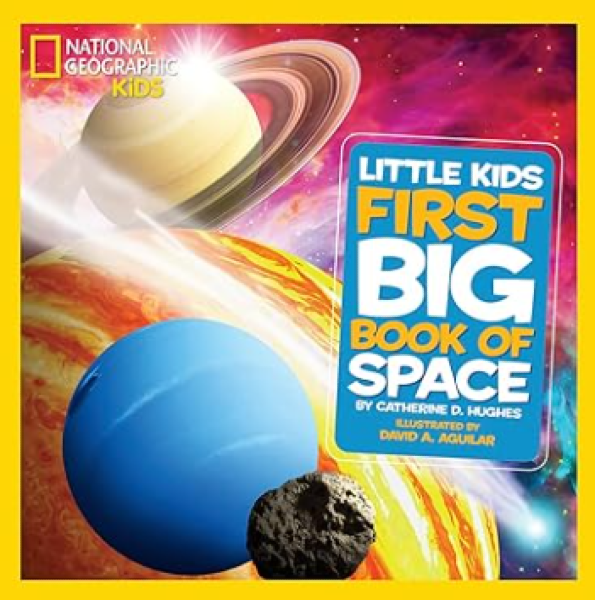
There's no story here. No character, no journey, no problem to solve. And for the right kid, that's exactly the point.
This is a reference book for children who want actual information. It starts with Earth and the moon, things a five-year-old already knows about, and moves outward: the solar system, dwarf planets, comets, the universe, black holes, space exploration. The structure is sensible. A younger child can stop at Saturn and feel satisfied. An older one who wants to know what's past the galaxy will find that too, a few pages on. Nobody gets left behind.
The illustrations are the reason to buy this over a cheaper alternative. David Aguilar paints space the way it actually looks in serious astronomy: vast, strange, slightly hard to take in. Saturn looks like it's showing off. The spread on the Milky Way is the kind of image that makes a child go quiet for a moment and then immediately ask a question they didn't know they had. These aren't cartoon rockets and cheerful moons. They're the real thing, rendered with enough detail that a kid who stares long enough will keep finding things to notice.
Reading it aloud works fine. The text is short and direct, one or two sentences per entry, easy to move through at bedtime pace. But this isn't really a read-aloud book the way a picture book is. It's a sit-together-and-look book. The conversations happen around the page, not from it. You read a fact about Jupiter's Great Red Spot, a storm roughly the size of Earth, your kid stares at the image for a while, and then the questions start. That's the experience the book is designed for.
The "fun facts" scattered in boxes throughout are hit and miss. Some are genuinely interesting, the kind of thing a child repeats at school the next day. A few feel like they're there because the layout needed filling. A curious seven-year-old will spot the ones that don't add much, and they will tell you, with some disappointment.
Worth knowing before you buy: the book was first published in 2012, and some of the science shows its age. There's a second edition now, updated with better photography and revised content, and if you're buying new, that's the one to get. The original still works, but check which version you're ordering.
This is a book for kids who sit still and want to know things. Not the ones who lose interest when there's no character to follow. The ones who ask why and don't want a simplified answer. The ones who will come back to this on their own, open it to a random page, and read it quietly on the floor while they're supposed to be getting ready for school. Those kids will use this book for two or three years.
If the Saturn spread is the page that gets returned to most, the Saturn guide on this site is where that curiosity goes next. Rings made of billions of pieces of ice, a moon where it rains methane, and the fact that those rings are slowly disappearing.