The Moon Used to Be Closer
The Moon hasn't always been where it is now. Four billion years ago, our day was six hours long because the Moon was much closer. It's been pulling away ever since, slowly enough you can't see it, but enough that total solar eclipses won't last forever.
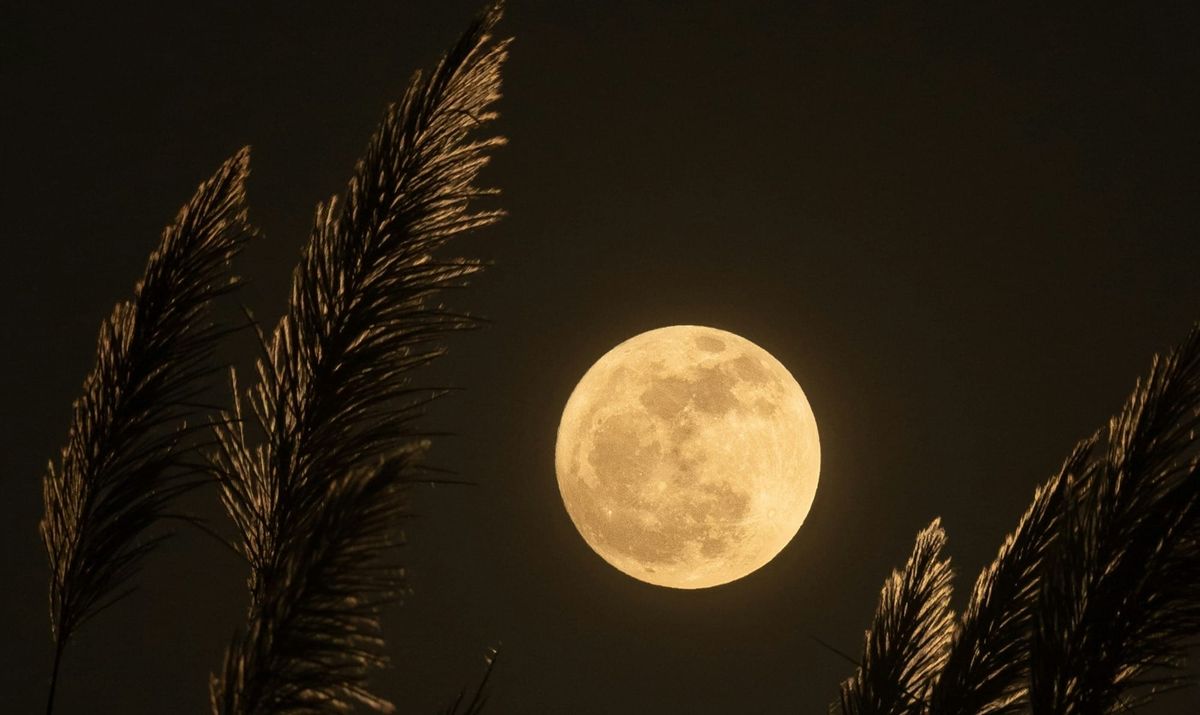
Two facts about the Moon, both about something most of us never think about: the Moon hasn't always been where it is now. It has been moving the whole time. Slowly enough that you can't see it, but quickly enough that every astronaut who left a footprint up there came back to a Moon already a few centimetres further from Earth than when they had left.
The Moon and the Earth have been quietly changing each other for four and a half billion years. Most of it happened long before anyone was around to notice.
Earth used to spin much faster, and the Moon is the reason it slowed down.
Roughly four billion years ago, when the Moon was newly formed and much closer to Earth, the day was about six hours long. The sky brightened and darkened four times as fast as it does now. There were no plants, no animals, nothing yet to notice this, but it was happening.
Then the Moon's gravity went to work. Tides on Earth (water sloshing toward whichever side of the planet the Moon happens to be closest to) act like a brake. They slow Earth's rotation by a tiny amount every day. Over hundreds of millions of years, those tiny amounts add up. Days got longer. Six hours became eight, became twelve, became twenty-four. We are still slowing down, by about 1.7 milliseconds per century. Far too slow to notice in a human lifetime, but enough that the dinosaurs lived through 23-hour days and trilobites lived through 21-hour ones.
The Moon is what we have to thank, or to blame, for losing those extra wakeups.
The Moon is leaving us, at the speed your fingernails grow.
Every year, the Moon drifts another 3.8 centimetres further from Earth. We know this very precisely, because Apollo astronauts left mirrors on the lunar surface and we still bounce lasers off them from observatories on Earth. The bounce comes back a tiny bit slower every year. The Moon is further away.
This is the other side of the same coin as Fact 1. Earth's lost spin has to go somewhere, and that energy is pushed into the Moon's orbit. Earth gives up its rotation. The Moon gets a slightly bigger orbit. Nobody planned this. It is just what happens when two big rocks share a gravitational dance for billions of years.
The result, on a scale much longer than human history, is that total solar eclipses will eventually become impossible. Right now, the Moon is at exactly the right distance to cover the Sun completely from Earth's point of view. That is a coincidence. In a few hundred million years, the Moon will be too small in our sky to fully cover the Sun. Future humans, if there are any, will only ever see annular eclipses, where the Sun stays as a thin ring around a smaller Moon.
If you ever do get to see a total solar eclipse, that's not just a rare event. It is a cosmic accident with an expiry date. We are alive in the sweet spot, on a planet that is still slowing down, watching a Moon that is still leaving. The same Moon that always shows us the same face is also, very slowly, on its way out the door.
If the Moon's slow changes are interesting, the not-so-slow ones are a different kind of strange: the Moon is also shrinking, cracking, and getting moonquakes in our lifetimes. Same neighbour, very different timescales. And on much longer timescales still, Saturn's rings are quietly disappearing by a similar logic. Things in the sky look fixed. They almost never are.