The Penny Bridge
A flat sheet of paper holds one penny before it gives up. Fold the same sheet into a concertina and it holds twelve. Sam was eight, in wet socks, and wanted to know why real bridges don't bend. Twenty minutes at the kitchen table, and he worked it out himself.
It started because Sam was trying to cross a puddle.
There was a long one on the path outside the house, and he'd been laying sticks across it end to end, trying to make something he could walk on. The sticks kept sinking. He tried a flat piece of bark. That sank too.
"Why does it not work?" he said, standing there in wet socks.
"Because the sticks bend when you stand on them. And the bark isn't strong enough to hold you."
"So how do real bridges not bend?"
I thought about it. "Come inside. I'll show you something."
I dug around and found a stack of flat paper, two books roughly the same height, and a small tub of one and two pence pieces we'd been meaning to take to the coin machine for about three years.
"Right," I said. "Let's see how strong paper is."
He looked doubtful.
The Setup
I put the two books on the table, about fifteen centimetres apart, and laid a single sheet of A4 paper across the gap. A bridge, technically. A very bad one.
"Put a penny on it."
He placed one penny in the middle with great care. The paper sagged, the penny slid toward the centre, and the whole thing drooped into the gap between the books.
Sam laughed. "That doesn't work at all."
"No. So how do we make it better?"
He poked at the drooping paper. "Thicker paper?"
"We've only got this paper. What else could we change?"
He thought. "Fold it?"
"Try it."
He folded the paper in half and laid it back across the books. It held one penny. On the second penny it collapsed.
"Better," he said. "But still not great."
The Folding Phase
This is the bit I didn't want to rush. I kept handing him fresh sheets and asking what he wanted to try next.
He folded one into quarters. That held three pennies.
He rolled one into a tube. The tube held six before it buckled sideways and sent the pennies skidding across the table.
Then he did the thing I was waiting for. He took a fresh piece of paper and folded it back and forth into a concertina. Small even folds, all the way along.
He laid it across the gap. It looked a bit ridiculous. Like a paper fan someone had flattened out.
"Put a penny on it," I said.
He did. Nothing happened.
"Another."
Nothing.
By penny seven he was leaning forward with his hands on the table. By penny ten the folds were starting to lean. At penny twelve the whole thing gave out with a small, sad crumple, and the pennies slid off in different directions.
He stared at it. "Why does the folded one hold more?"
"That," I said, "is the question."
The Science Bit
"What happened when you put a penny on the flat paper?"
"It bent."
"Where did the weight go?"
He thought. "Down. Into the paper."
"And the paper had nothing to push back with, because it was just one flat sheet. So it bent. Now what about the folded one? When you pushed down on the top of a fold, where did the weight go?"
He traced the zigzag with his finger, up one side and down the other. "Sideways?"
"Sort of. Down one side of the fold, and then the next fold catches it, and then the next one. The weight gets shared out. Each fold takes a little bit, instead of one flat sheet taking all of it."
He looked at the crumpled concertina on the table. "So folds are like lots of little legs."
"That's a pretty good way of putting it."
The Testing Phase
Once he had the idea, he got the look on his face I know well. The look that means he is about to invent a variable I would not have thought of.
"What if," he said, "the pennies were wet?"
I blinked. "Wet?"
"If it was raining. On the bridge. Would wet pennies be heavier?"
"Pennies don't really absorb water. But the paper would."
His eyes widened.
(This is the age when everything is worth testing — not because anyone told them to, but because they've just worked out that they can.)
We got a fresh concertina bridge and a small cup of water. He dipped his finger in and flicked a few drops along the top of the folds. The paper darkened along the creases, the folds softened, and when he placed the first penny on, the whole bridge sagged sideways and collapsed at penny three.
"Three," he said, with the solemnity of someone recording a catastrophic result. "It used to be twelve."
He reached for another sheet.
"I want to test how wet is too wet."
We tested three levels of damp. One flick of water, three flicks, and a thoroughly soggy sheet we'd held briefly under the tap. The one-flick bridge held eight pennies. The three-flick bridge held four. The soggy one collapsed under its own weight before we got a penny anywhere near it.
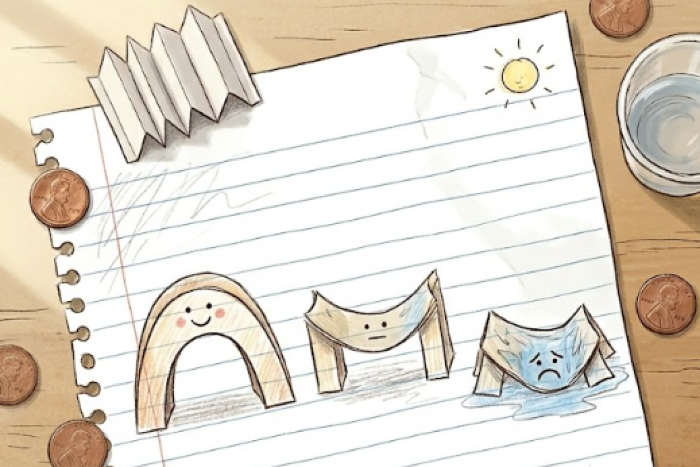
He drew the results on a piece of paper, which was mostly three bridges with sad faces at different levels of droop, and a small sun in the corner for the dry one.
The Next Day
He told his mum at breakfast that bridges fall down in the rain because "the folds get soft."
This is not exactly why real bridges sometimes fail. But for an eight-year-old who had spent twenty minutes folding paper and flicking water at it, it was honest work.
The drawing of the three sad bridges made it onto the fridge.
Your Turn
You need four things: paper, two books or boxes roughly the same height, a pile of coins, and a gap between the books of about fifteen centimetres.
Start with a flat sheet. Watch it fail. Then start folding.
Try a single fold, a tube, a concertina, a triangle. See which one holds the most. Then let them invent their own variable. Wet paper. Two sheets glued together. A fold inside a fold. The point isn't to find the strongest design. The point is to work out why one shape holds more than another.
If your child liked the folding-and-failing rhythm of this one, the egg drop challenge works the same way. Pick a thing to protect, build around it, drop it, find out if you were wrong. Different materials, same instinct.
The folds are doing all the work. You just have to watch how.
