How Long Would It Take to Count to a Billion?
In December 2025, Favour Ogechi Ani finished counting to 1,070,000 out loud. It took seventy days. At her pace, counting to a billion would take more than a century. The gap between those two words is the gap most adults cannot feel.
In December 2025, a Nigerian woman called Favour Ogechi Ani finished counting to 1,070,000 out loud. Seventy days, fourteen hours a day, broadcast live on YouTube. Guinness confirmed her as the new world record holder for the highest number counted aloud in March 2026, ending the eighteen-year reign of Jeremy Harper, an American who had counted to a million back in 2007.
Neither of them came close to a billion.
At Ani's spoken pace, counting to a billion non-stop would take more than a hundred years. Even at the theoretical maximum of one number per second, never sleeping, the answer is thirty-one years and eight months. Most adults, asked to guess, will say something like a year. Some will say a decade. Almost no one says thirty.
The number that breaks intuition
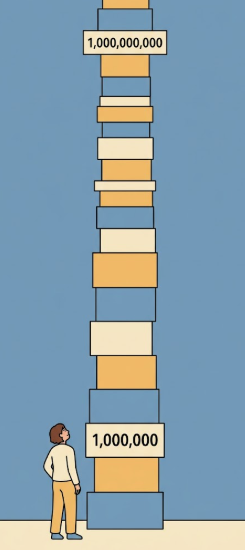
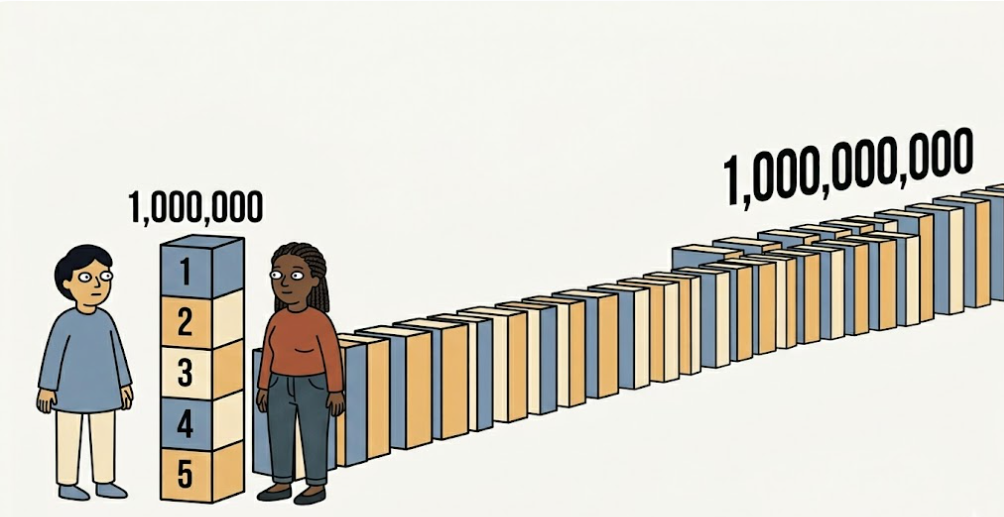
Counting to a million takes about twenty-three days at one number per second, without stopping. Counting to a billion takes thirty-one years at the same pace. That gap looks wrong to most people. A billion is only one zero longer than a million. It feels like it should take ten times as long, not a thousand times.
But that is the trick. Each new zero multiplies the previous total by ten. A million is six zeros. A billion is nine. The three extra zeros turn weeks into decades. And in real spoken counting, where the long numbers take a few seconds each to say, the ratio gets worse. Ani averaged roughly three seconds per number. Harper, working with a slower rhythm, averaged closer to five.
What a billion of anything actually means
A million seconds ago was about eleven days ago. A billion seconds ago was the autumn of 1992. Bill Clinton had just been elected president of the United States. The first series of The X-Files had not yet aired.
This works for things other than time. A million pounds, in twenty-pound notes, makes a stack about five metres tall. A billion pounds in the same notes makes a stack five kilometres tall. A million bricks builds a small block of flats. A billion bricks builds something on the scale of the Great Wall of China.
A million is large. A billion is in a different category of large. The two words sit next to each other in the dictionary, which is part of the problem.
Why our brains cannot feel the difference
Children, and most adults, can intuitively sense the difference between three apples and four. They can roughly compare ten and a hundred. Beyond that, the felt sense of size collapses. A million and a billion both register as "very big," and the brain does not naturally scale up the way the maths does.
Researchers in numerical cognition call this the logarithmic mental number line. Work by Stanislas Dehaene and colleagues at the Collège de France found that we perceive number size on a compressed scale, in the same way we perceive sound or light. Doubling the loudness of a noise does not feel twice as loud. Doubling a number, past a certain size, does not feel twice as big.
This is not a flaw to fix. It is how the brain has always worked. But it is worth knowing, because the difference between a million and a billion is the difference between a flat and a tower block. Sometimes the difference between a small budget overrun and a national crisis.
The bit no one teaches in school
Children learn to write a million and a billion long before they learn to feel them. The curriculum will ask a child to add up large numbers, but rarely asks them to sit with what one of those numbers actually means. The idea that a billion is just a slightly bigger million is one most adults still carry around.
Number sense, the feel for how big a number really is, does not show up well on tests. It is also one of the things that quietly separates children who find later mathematics intuitive from children who find it baffling. The skill of noticing when a number sounds wrong gets built early, and not always at school.
How to give a child the feel of it
Ask a child to count from one to a hundred and time them. Then ask how long they think it would take to count to a million. Their guess will probably be off by a factor of ten or more. The conversation that follows is the lesson.
Other versions: work out together how far a million paces would take you walking, then a billion. Find out together when a million seconds ago was, and when a billion seconds ago was. Look up Favour Ogechi Ani's seventy days of counting. Watch a few minutes of her livestream. Look at how long it took her to do something most children assume could be done in an afternoon.
None of this will turn a child into a mathematician. It will not raise a test score next term. It builds a different thing: the muscle that lets a child notice when a number sounds wrong, when a quantity does not add up, when one word has been quietly swapped for another.
A child who can feel the gap between a million and a billion has built the start of that muscle. The number is not the point. The feel for the number is.