The £5 Robot You Can Build at the Kitchen Table
en minutes, about five quid, and you've got a real robot skittering across the kitchen table. A toothbrush head, a vibration motor, a coin battery. No app, no remote, no screen. It rarely goes in a straight line and that's the whole charm. Plus the backup plan.
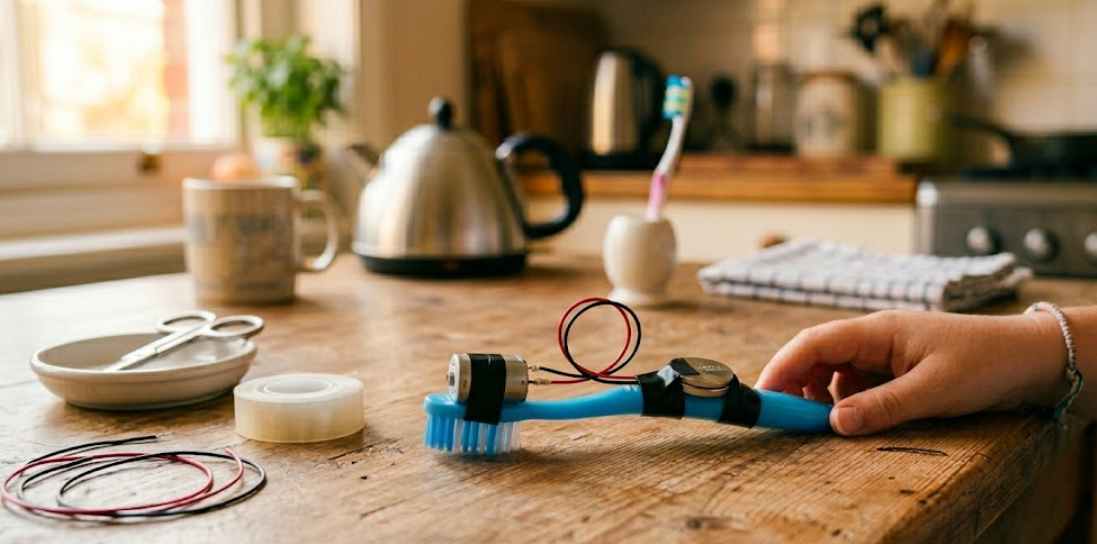
It's a wet Sunday. The kind where you've already done the park (briefly), the colouring (reluctantly), and you're now being asked, with increasing urgency, what's next. You're eyeing the iPad. Again.
Here's what you do instead. You build a robot. A real one. It moves on its own, it has a motor, and it will cost you about the price of a coffee. It also takes about ten minutes to make and will genuinely amaze a six-year-old, which is not a sentence I write lightly.
It's called a bristlebot. And it's the best rainy-afternoon save I've found in ages.
What it actually is
Imagine the head of a toothbrush, flipped upside down so the bristles are on the floor. Glued to the top is a tiny motor about the size of a pea, the kind that makes your phone buzz. Next to the motor sits a little coin battery, taped down. When the motor spins, the whole thing vibrates, and because the bristles are angled, the vibration walks the toothbrush across the table in mad, lurching zigzags.
That's it. That's the robot. It has no brain, no remote, no app. It just goes. And somehow, that makes it more exciting, not less. Your kid will chase it around the table and laugh.
If you're reading this thinking I don't know the first thing about motors and I'm going to break something, you won't. This is exactly the kind of project that looks technical and isn't. The hardest part is finding the scissors.
What you need
- A cheap toothbrush (the angled kind with slanted bristles works best)
- One small vibration motor (sometimes called a "pager motor" or "coin motor", about £1-2 online)
- One CR2032 coin cell battery (the flat round ones, you probably have a spare in a drawer)
- Double-sided foam tape or a glue dot
- Small scissors or wire cutters to snip the toothbrush head off the handle
That's everything. If you search "mini vibration motor" on Amazon you'll find packs of ten for about £4, which is either excellent value or a commitment to building ten robots. Both are fine.
How to build it
Snip the head off the toothbrush so you're left with just the bristly bit, about 3cm long. Stick a small square of double-sided tape on the flat back. Press the motor onto the tape so it's stuck down firmly. Then touch one of the two little wires from the motor to one side of the coin battery, and the other wire to the other side. The motor will start buzzing immediately. Tape the battery down so both wires stay pressed against it, and the whole thing will start skittering across the table.
If it doesn't move, flip the toothbrush over and check the bristles are splayed out properly. If it spins in circles instead of going forward, that's actually the normal behaviour and it's delightful. More on that in a second.
The honest bit
Bristlebots are chaotic. That's the whole charm and also the whole problem. They rarely go in a straight line. They spin. They fall off the table. They sometimes just vibrate angrily in one spot and refuse to move, and you'll have to adjust the motor position by a millimetre to fix it.
Your kid will want it to race. It will not race. It will do a confused pirouette and then drive into a pencil. This is fine. Make a little arena out of a baking tray or the lid of a shoebox, and suddenly the chaos has somewhere to happen. You can add obstacles, draw a track, build a maze out of dominos. The robot is the starting point, not the finish line.
Also, a word on the motor wires. They are very fine and they do snap if your kid yanks them, which they will. Have a spare motor. I'm serious. If you're buying them anyway, buy more than one.
If the bristlebot ends in frustration, or finishes too fast, or one of those wires snaps and you haven't got a spare, there's a backup that uses most of the same drawer. A coin battery, some lolly sticks, and the will to launch a marshmallow across the kitchen. Same twenty minutes, different mess.
Why it counts as robotics
Because it is robotics. A robot, in the broadest sense, is a machine that moves on its own once you switch it on, and this is that. Your kid is building a circuit (battery to motor and back again), learning that electricity makes things move, and watching vibration turn into directed motion. That last bit, by the way, is how some real robots actually walk. It's called passive dynamic locomotion and engineers use it in everything from warehouse sorters to tiny medical robots.
Your seven-year-old doesn't need to know any of that. They just need to see the thing they built with their own hands scoot across the table like it's alive.
And if it turns out they love it, if the bristlebot becomes the first of a long line of things they want to build and break and build again, that's when the kit question starts to matter. There's a whole guide to what's actually worth buying under £85 for this age group, and it's mostly about what to avoid.
The quiet bit at the end
There's a specific moment, right after the motor starts spinning and the whole contraption lurches off the table, when a kid's face does a particular thing. It's the look of having made something that then surprised them. Not something that sits there looking pretty. Something that does a thing. That they built.
You can't buy that look. But you can, it turns out, build it for about five quid.