The Day We Launched a Marshmallow
It started because Noor wanted to launch a marshmallow. Not eat it. Launch it. Five popsicle sticks, a rubber band, and one very determined child later. She called it "the stick being angry."
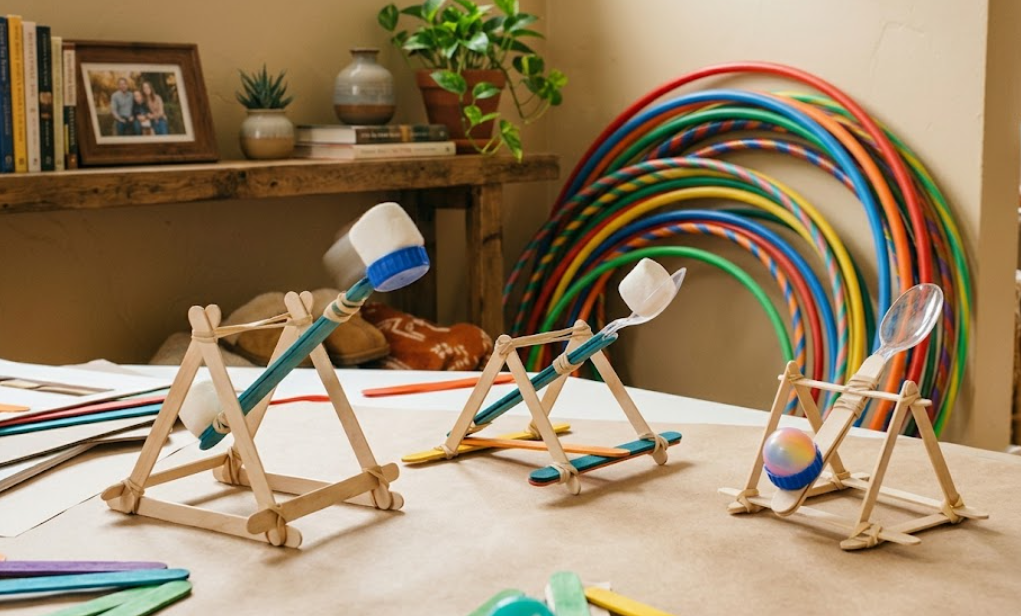
It started because Noor wanted to launch a marshmallow. Every child, at some point, looks at a perfectly good snack and thinks: but how far would it go?
Not eat it. Not squash it. Launch it. She'd been building something out of popsicle sticks at the kitchen table for about ten minutes, stacking them and letting them spring apart, and had arrived at the conclusion that they were basically weapons.
"I need to make a catapult," she said, with the calm certainty of someone who has thought this through.
I looked at the pile of popsicle sticks, the rubber bands holding together a bunch of markers in the pen pot, and the marshmallow she'd placed carefully on the edge of the table like a very small cannonball.
"Alright," I said. "But we're doing it properly."
She nodded. Properly was acceptable.
The Setup
We started with a stack of five popsicle sticks, bundled together at both ends with rubber bands. This was the base. Noor wrapped the bands tightly, which she was good at, and held it up for inspection.
"Now what?"
"Now we need the arm." I took two more popsicle sticks and bound them together at one end only, so they opened like a crocodile mouth. Then we wedged the fat stack of five between the two loose ends, pushing it as close to the bound end as we could manage.
One more rubber band to hold the whole thing together where the stack crossed the arm, and we had something that looked, honestly, like a catapult built by someone who'd been told what a catapult was but had never actually seen one.
Noor placed the marshmallow on the end of the top stick.
"Ready?" she said.
"Ready."
She pressed down on the arm and let go.
The marshmallow shot off the table, hit the fridge, and bounced onto the counter.
Neither of us said anything for a second.
"Again," she said.
The Science Bit (Which Happened Naturally, I Promise)
After the fourth marshmallow (two hit the fridge, one hit the floor, one landed in the dog's water bowl, which Noor considered a precision strike), she stopped and looked at the catapult.
"Why does it go so far?"
"What do you think is happening when you push the arm down?"
She pressed it slowly this time, watching the popsicle stick bend. "It's... storing up?"
"Storing up what?"
She thought about this. "Energy?"
"Exactly. When you push the arm down, you're putting energy into the stick. It wants to spring back. And when you let go..."
"All the energy comes out at once." She flicked it without a marshmallow, just to watch the arm snap up. "Like a spring."
"That's called elastic potential energy. The stick bends, stores energy, and when you release it, the energy transfers to whatever's sitting on the end."
She placed another marshmallow on the arm. "So a heavier thing would go less far?"
"What do you think?"
"Because the energy is the same but it has to move more stuff." She looked around the kitchen. "Can I try a grape?"
The grape went about half the distance. She stared at it on the floor, then back at the catapult, then at me.
"More mass," she said.
"More mass."
The Testing Phase
Once she had the basic idea, she became methodical in the way children do when they've decided something is worth taking seriously.
She wanted to know: did it matter where the stack sat? (We moved it closer to the launching end. The arm had less room to bend, and the marshmallow barely cleared the table. She moved it back.) Did more popsicle sticks in the base make it stronger? (We added three more. The arm was stiffer, harder to press down, but the marshmallow went further. She described this as "more spring.") What about the angle? (She tried pressing the arm down only halfway. The marshmallow rolled off the end pathetically. "Not enough energy," she said, which was exactly right.)
Then she asked the question I liked best: "What if we made the arm longer?"
We taped two popsicle sticks end to end for a longer arm. The marshmallow went noticeably further, which thrilled her, but the arm also wobbled and the aim was terrible.
"It's more powerful," she said, frowning at the marshmallow that had gone sideways into a chair leg, "but it can't aim."
She grabbed an envelope from the recycling and started drawing what she called "the catapult results." It was a diagram showing three catapults of different sizes with dotted lines indicating marshmallow trajectories. The longest arm had a note next to it that said "strong but wonky."
Her dad came in and looked at the marshmallows on the floor, the grape by the bin, and the catapult held together with rubber bands and optimism.
"Physics," I said.
"Right," he said, and stepped over the grape.
The Next Day
She brought the catapult to breakfast in a sandwich bag, which I thought was a nice touch. She told her mum that catapults work because of "elastic potential energy, which is basically the stick being angry," and that longer arms are more powerful but less accurate, which is why trebuchets needed to be enormous.
I don't remember telling her about trebuchets. She may have looked it up. She's that sort of child.
The catapult diagram made it onto the fridge. The grape stain on the kitchen floor took two days to notice and another one to clean.
Your Turn
You need popsicle sticks (seven or eight will do), a few rubber bands, and something small to launch. Mini marshmallows work well. So do dried pasta, small pom-poms, and blueberries if you have them. Grapes work but don't go as far, which is half the point.
Build the base stack first, then the arm, then start adjusting. Move the stack forward and back. Add more sticks. Try a longer arm. Try launching different objects and see which ones go furthest and which barely leave the spoon.
The conversation you want is the one where they figure out that the same catapult sends light things far and heavy things nowhere, and then start asking why. That's the bit where the physics arrives, and it arrives because they wanted to launch a marshmallow, not because anyone mentioned the word "energy."
If they ask whether they can try it outside with a tennis ball, say yes, but maybe not aimed at the house. Some experiments scale better than others.