Math Facts That'll Make You Say "Wait, What?" #11
The digit 8 is three different numbers depending on how you slice it. The 9 times table doesn't just repeat. It builds perfect number pyramids. And spiders are doing geometry in the dark that humans needed centuries of maths to describe.
Math is weird in the best possible way. It's full of surprises that have nothing to do with tests or worksheets.
Here are some facts to share with your kid. Not because they're educational (though they are), but because they're genuinely cool. The kind of cool that makes you look at numbers differently.
The 9 Times Table Builds Perfect Pyramids
We already know nine has a trick with its digits. But it has another one that's even stranger.
Square the nines and watch what happens:
9 × 9 = 81 99 × 99 = 9,801 999 × 999 = 998,001 9,999 × 9,999 = 99,980,001
See it? The nines climb, a gap opens in the middle, and the pattern builds outward like a number mountain. Add more nines and the mountain gets taller. It never breaks. It never wobbles. It just keeps building, perfectly, every time.
Most times tables are just facts to memorise. This one is architecture. Someone discovered this pattern and it probably changed the way they looked at multiplication for good. Once you see the pyramid, you can't unsee it.
Write the sequence out with your kid. Go as far as you want. The mountain keeps growing.
We covered nine's digit-sum trick in Math Facts #6. Turns out that was only half of what nine can do.
The Number 8 Is Having an Identity Crisis
Half of 8 is 4. Everyone knows that.
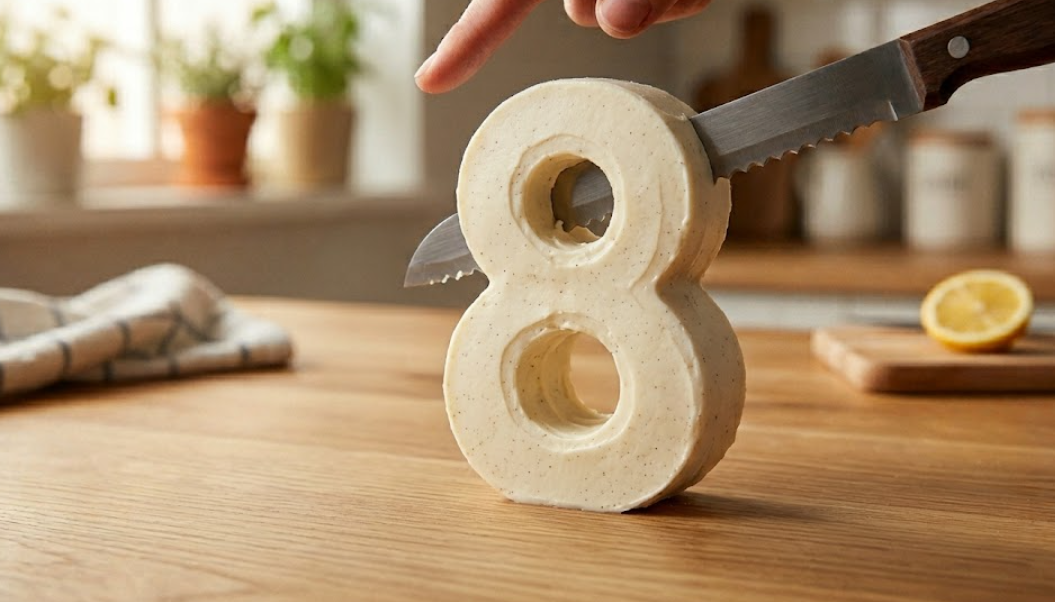
Here is where it gets odd though - this isn't deep maths, rather a a quirk of how we draw the number:
- Take the actual digit "8" and cut it in half horizontally, like slicing a bagel. You get two zeros stacked on top of each other: 0 and 0.
- Now cut it in half vertically, like slicing a loaf of bread. You get two threes facing each other: 3 and 3.
So depending on how you slice it, the number 8 contains 4, or 0, or 3. Three different numbers hiding inside a single digit, depending entirely on how you look at it.
Not deep math, but the kind of thing that makes a kid stare at an 8 for slightly too long and then start slicing other numbers in their head to see what's inside them.
Most numbers don't survive the experiment. Eight is unusually cooperative.
We looked at four standing alone in Math Facts #4. Eight, it turns out, can't even agree with itself.
Spiders Are Better at Geometry Than You
Spiders build webs using radial symmetry, evenly spaced anchor lines, and spiral patterns that distribute tension across the whole structure. They do this without measuring. Without rulers. Without any tools at all.
Some species rebuild their entire web every single night. From scratch. In the dark. And each web is geometrically precise enough that engineers have studied them for insights into structural design.
The silk itself is remarkable, stronger by weight than steel, but the geometry is the part that should bother you. A spider doesn't know what a radius is. It doesn't understand angles or symmetry as concepts. It just builds, and what it builds happens to follow the same principles that humans needed centuries of mathematics to formalise.
There's a version of this story where it's humbling. And there's a version where it's reassuring: the rules of geometry are so fundamental that even a creature with a brain the size of a poppy seed lands on them instinctively.
Either way, spiders are quietly outperforming most of us.
If you missed the bees building perfect hexagons without a geometry lesson, that's in Math Facts #5. Nature and numbers keep finding each other.
The best maths facts aren't the ones that help with homework. They're the ones that make a kid look at something ordinary, a times table, a digit, a cobweb in the garden, and realise there was something hiding in it the whole time.
That feeling is where curiosity starts. Everything else follows from there.