The Robot That Runs on Mushrooms
A robot at Cornell University walks on five soft legs, controlled not by code but by mushroom mycelium growing into its electronics. When the fungus senses light, the robot changes its gait. Nobody reprogrammed it. The mushroom decided.
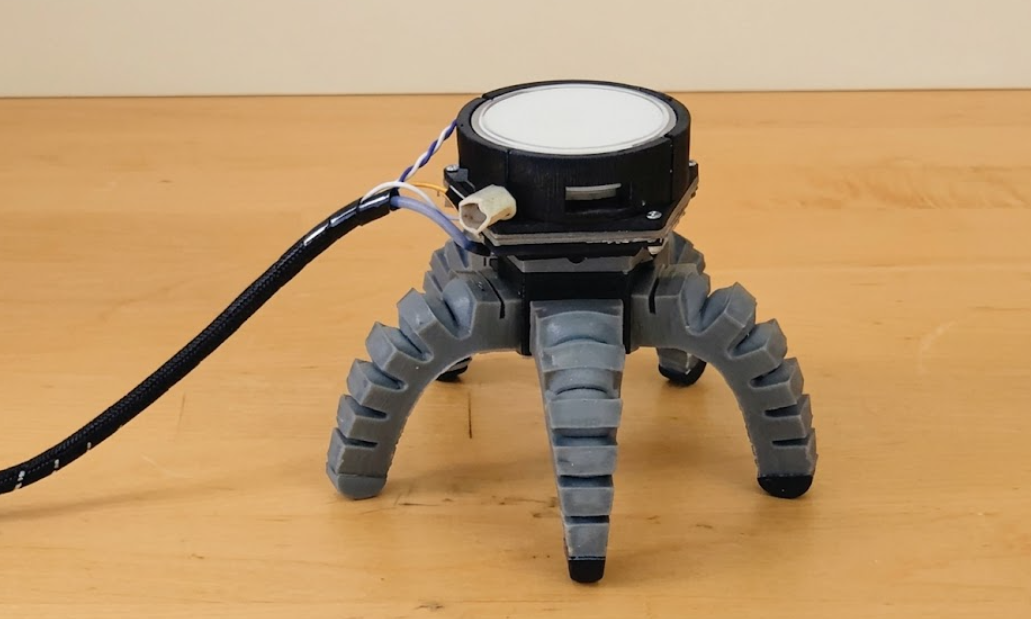
A starfish-shaped robot crawls across a lab floor at Cornell University. It has five soft legs, no battery in the traditional sense, and no pre-programmed instructions telling it where to go. What it has, growing directly into its electronics, is fungus. King oyster mushroom mycelium, to be specific. The mushroom is the brain.
The robot was built by Anand Mishra, an engineer in Cornell's Organic Robotics Lab, and published in Science Robotics in August 2024. Mishra's team grew mycelium, the threadlike root structures of mushrooms, directly into the robot's electrodes. Mycelia produce spontaneous electrical spikes, similar to the action potentials fired by nerve cells. Those spikes became the robot's control signals: the system reads the raw electrical activity, identifies the rhythmic patterns, converts them to digital commands, and sends them to the robot's legs. The mushroom fires. The robot walks.
That alone would be a curiosity. What makes it more than that is what happened when the team shone ultraviolet light on the mycelium. The electrical signals changed. The robot's gait changed with them. The mushroom sensed something in its environment, and the robot responded, without any human reprogramming.
They built two versions: the soft-bodied spider and a wheeled robot. Both moved under fungal control. Both responded to UV light. And in a third experiment, the team showed they could override the mushroom's signal entirely if they needed to take back control.
Why mushrooms, of all things
The problem with building robots from living tissue is keeping the tissue alive. Animal cells are fragile. They need precise temperatures, sterile conditions, and constant monitoring. Mishra points out that cultivating animal cells practically requires a biology degree. Mushrooms, by contrast, are robust. Fungal cells survive cold, radiation, salt water. You can grow them at home.
But hardiness is only half the argument. The real appeal is sensing. A synthetic sensor does one job. Mycelium responds to light, heat, touch, chemicals, and, as Mishra puts it, "even some unknowns." If something unexpected shows up in the environment, the mycelium reacts. The robot doesn't need to have been programmed for that specific input. It just needs to be alive.
The team used king oyster mushrooms partly because they are easy to cultivate and partly because their mycelia produce clear, recordable electrical signals. Getting a clean recording was one of the hardest parts of the project. The mycelial threads are extremely thin, and contamination is a constant risk. Mishra had to learn mycology, neurobiology, and signal processing alongside the mechanical engineering. Growing clean cultures alone required help from a plant pathologist.
Where this might go
The near-term application is agriculture. Mycelia are already exquisitely sensitive to soil chemistry. A fungal robot walking through a field could sense contaminants, pathogens, or nutrient levels that a synthetic sensor might miss, and it could do it without the environmental cost of electronics. As Vickie Webster-Wood, a biohybrid robotics researcher at Carnegie Mellon, has noted, sending a swarm of plastic-and-metal robots into a coral reef or a remote forest creates its own waste problem. A robot built partly from living material that can be grown on-site changes that equation.
There is even a space angle. Mycelium can survive radiation better than most living tissue. You could, in theory, send a small culture to a remote location and grow the biological components of a robot there, rather than shipping a fully assembled machine.
Why this matters for kids
Most children who are interested in robotics think of robots as machines: metal, code, motors. Most children who are interested in nature think of mushrooms as something that grows in the garden. This story sits exactly where those two interests meet, and that collision is what makes it worth sharing.
Ask your child: if a robot is partly alive, is it still a robot? If the mushroom is making the decisions, who is in control? These are not hypothetical questions any more. There is a five-legged robot on a lab floor in Ithaca, New York, and the thing telling it where to walk grew from a spore.
The researchers describe this work as a first chapter. It probably is. But it is a first chapter in which the line between the built and the grown got noticeably harder to draw.
Source: Mishra, A.K. et al. "Sensorimotor control of robots mediated by electrophysiological measurements of fungal mycelia." Science Robotics, Vol. 9, August 2024. Reported by Science News Explores and Cornell Chronicle.